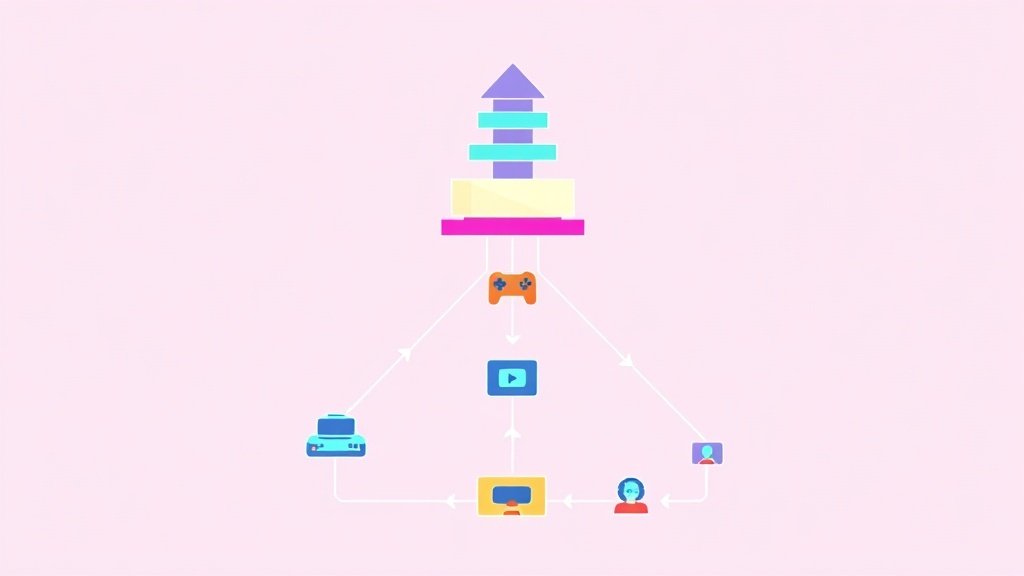
The digital entertainment economy, a behemoth forged by technological revolution and insatiable consumer demand, stands at an inflection point. Once defined by burgeoning growth and expanding addressable markets, its current landscape is characterized by fierce competition, escalating infrastructure costs, and a ruthless zero-sum game for the ultimate scarce resource: consumer attention. For industry leaders, investors, and innovators, understanding the intricate interplay between distribution, infrastructure, advertising, and attention economics is no longer a luxury but an existential imperative.
Distribution has evolved from a channel-centric model to a hyper-fragmented, multi-platform battlefield. The streaming wars, while driving unprecedented content investment, have also led to subscription fatigue and a perplexing paradox of choice for consumers. This dynamic is shifting power, not just to content creators, but to super-aggregators and platform owners who control discovery and access. The next frontier in distribution will undoubtedly be shaped by spatial computing, where immersive experiences bypass traditional screens, demanding direct-to-headset or ambient environment delivery, potentially re-bundling or further fragmenting the user journey. The strategic move now is not just about owning content, but owning the *pathway* to consumption, whether through hardware, OS, or a dominant UI.
Underpinning this entire ecosystem is a colossal and increasingly complex infrastructure. Cloud computing giants provide the backbone, handling petabytes of data, real-time transcoding, and global content delivery. Low-latency networks, sophisticated content delivery networks (CDNs), and advanced cybersecurity protocols are non-negotiable necessities, not competitive advantages. The scale and cost of this infrastructure are immense, forming a natural barrier to entry and a perpetual drain on profitability for even the largest players. As spatial computing moves from nascent to mainstream, infrastructure demands will skyrocket – requiring unprecedented edge computing capabilities, real-time rendering at scale, and hyper-efficient data pipelines to power persistent, immersive virtual worlds. Investment in resilient, scalable, and AI-optimized infrastructure is the silent war waging beneath the surface of glitzy content announcements.
Monetization, particularly through advertising, is experiencing its own seismic shifts. The traditional linear TV advertising model has been irrevocably disrupted by programmatic, data-driven digital alternatives within the walled gardens of dominant platforms. However, escalating privacy regulations and the impending deprecation of third-party cookies are forcing a reckoning, pushing advertisers towards first-party data strategies and contextual targeting. Simultaneously, subscription saturation has seen the re-emergence of ad-supported video on demand (AVOD) and free ad-supported streaming television (FAST) models, signaling a re-calibration of consumer willingness to pay. For spatial computing, advertising models are still embryonic but will likely lean into native, context-aware, and highly personalized integrations that are less intrusive and more experiential, blurring the lines between content and commerce within virtual environments.
Ultimately, all these pillars converge on the economics of consumer attention – the most precious commodity in the digital age. From the “battle for the thumb” on mobile devices to the relentless algorithms of TikTok and YouTube optimizing for engagement, the design of digital entertainment is increasingly about maximizing time on platform. The rise of the creator economy and user-generated content (UGC) is a testament to this, as platforms leverage communities to generate an endless stream of attention-grabbing material. Yet, there’s a growing awareness of “attention residue” and the cognitive load imposed by constant digital bombardment. Future success will hinge on moving beyond mere engagement metrics to fostering genuine, valuable interaction and community. Spatial computing, by its very nature, demands active rather than passive consumption, offering a unique opportunity to cultivate deeper, more meaningful attention – a paradigm shift from endless scrolling to purposeful presence.
The digital entertainment economy is a marvel of human ingenuity and technological prowess, yet its future success hinges on strategic acuity. Players must move beyond siloed thinking, recognizing the deep interdependencies of distribution, infrastructure, advertising, and attention. Agility, coupled with a willingness to invest in the next generation of computing paradigms like AI and spatial computing, will differentiate those who merely participate from those who truly own the future of entertainment. The apex game is not just about content; it’s about mastering the entire value chain in an increasingly complex and competitive digital universe.