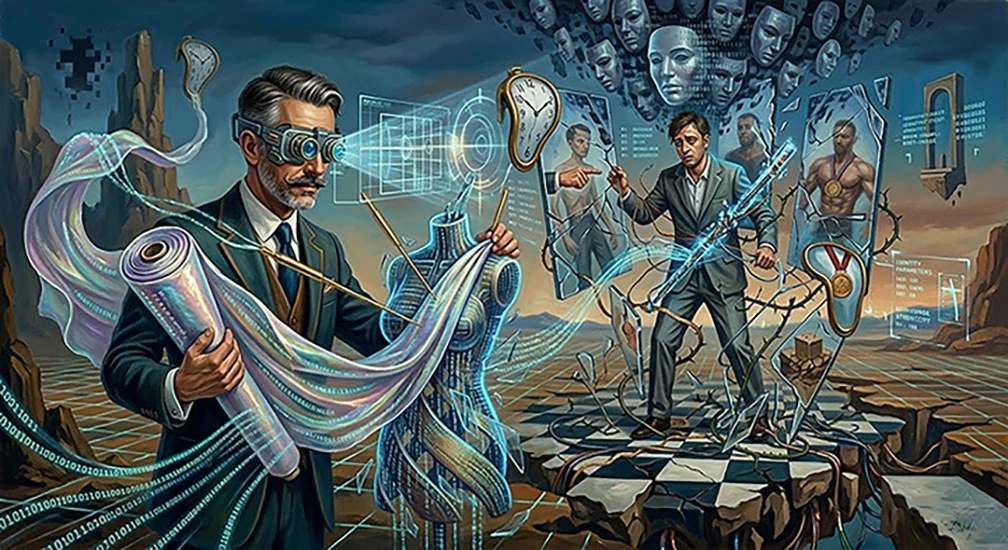
When a designer or tailor opens 3.25 meters of a worsted suit length and lays it on the table, the very first thing his fingers feel is the fineness of the texture—the smoothness, the bounciness, and the exact quotient of stretchability of a highly twisted yarn of this fine, high-yarn-count worsted fabric ready to be drafted, cut, basted, and loosely hand-tacked to be draped for the first trial on the body.
Even as the fabric lays there, the mind of the tailor already sees the outline of the body, the contours and its sudden changes—the fat deposits on the sides and underarms, the swell of the abdomen, and the very frame that has worn out with aging, with the droop of left or right shoulder depending upon the right-handedness or left-handedness of the person. He is calculating the stoop of the upper backbone, the turning of the atlas bone, the sagging of the hips, and the changes in the fibula and knee that define the length and curvature. The aim is to cover the follies earned with the age and get the the statement that is deserved.
Is not this imagination itself a Virtual World operating within his own mind?
The reality is that software like Marvelous Designer, WebGL, and the people who run them have still not reached these levels of real-world problem solving that a master tailor and draper executes naturally. Tech companies view virtual environments and VR garments purely as a mathematical problem of light and rendering. They completely miss the chemistry and the tactile functions of how human nerves register fabric against the skin, apart from the sheer technique and training required to understand how the invisible force of gravity gives a garment its true shape.
Human vision evolved strategically over thousands of years; our two eyes perceive depth and light to solve spatial problems in the physical world. Yet, the engineers building these multi-billion-dollar spatial computing pipelines are trying to code a virtual world without ever mastering the physics of the real one.
The Financial Seams of Streaming & Tech
We see this exact same structural flaw when we look at the business end of things in the cinema and streaming industries. Media companies are trying to drape heavy CGI and bloated tech overheads over fundamentally broken scripts and collapsing business models.
Just like an expensive piece of fabric cannot save a badly cut 2D pattern, a new streaming app cannot hide a broken ecosystem. They are chasing the digital illusion while ignoring the core infrastructure—the long-term semiconductor pipelines and hardware—that actually holds the tech industry together at the seams.
The Chemical Filter: GLP-1s and the Perception of Self
This disconnect travels straight into the wellness economy with the sudden explosion of GLP-1 drugs like Ozempic and Mounjaro. While these bio-drugs are massive milestones for chronic lifestyle diseases, the current societal pressure is driving healthy individuals to use them off-label just to chemically tweak their physical bodies to fit a standardized layout.
Think about the effect this has on the consumer’s pocket, and the bottom lines of companies like Novo Nordisk executing smart patent tweaks for oral tablets to capture more market share. But look deeper at what goes on in human minds: the over-information clutter, the anxiety it causes, and the deep rejection of the physical form. Instead of using a master tailor to build a silhouette that honors and covers a physical defect with dignity, society is choosing a chemical quick-fix to erase the self.
This directly ruins how humans will perceive themselves in the virtual worlds we are building. If we cannot tolerate our own physical reality, our natural aging, or our structural asymmetries, VR environments will not become spaces for human connection—they will become a fractured hall of mirrors. Users will project hyper-idealized, frictionless avatars that completely lack human history.
For the tech founders and venture capitalists pouring capital into the metaverse, this is the ultimate blind spot. You cannot engineer genuine human immersion inside an ecosystem built on body anxiety and self-rejection. Whether you are running a garment manufacturing unit, analyzing a tech equity portfolio, or designing a virtual world, the true product is never the underlying code or the machine.
The product is always the human perception of self.
Sandeep Verma Editor-in-Chief, OTTTimes